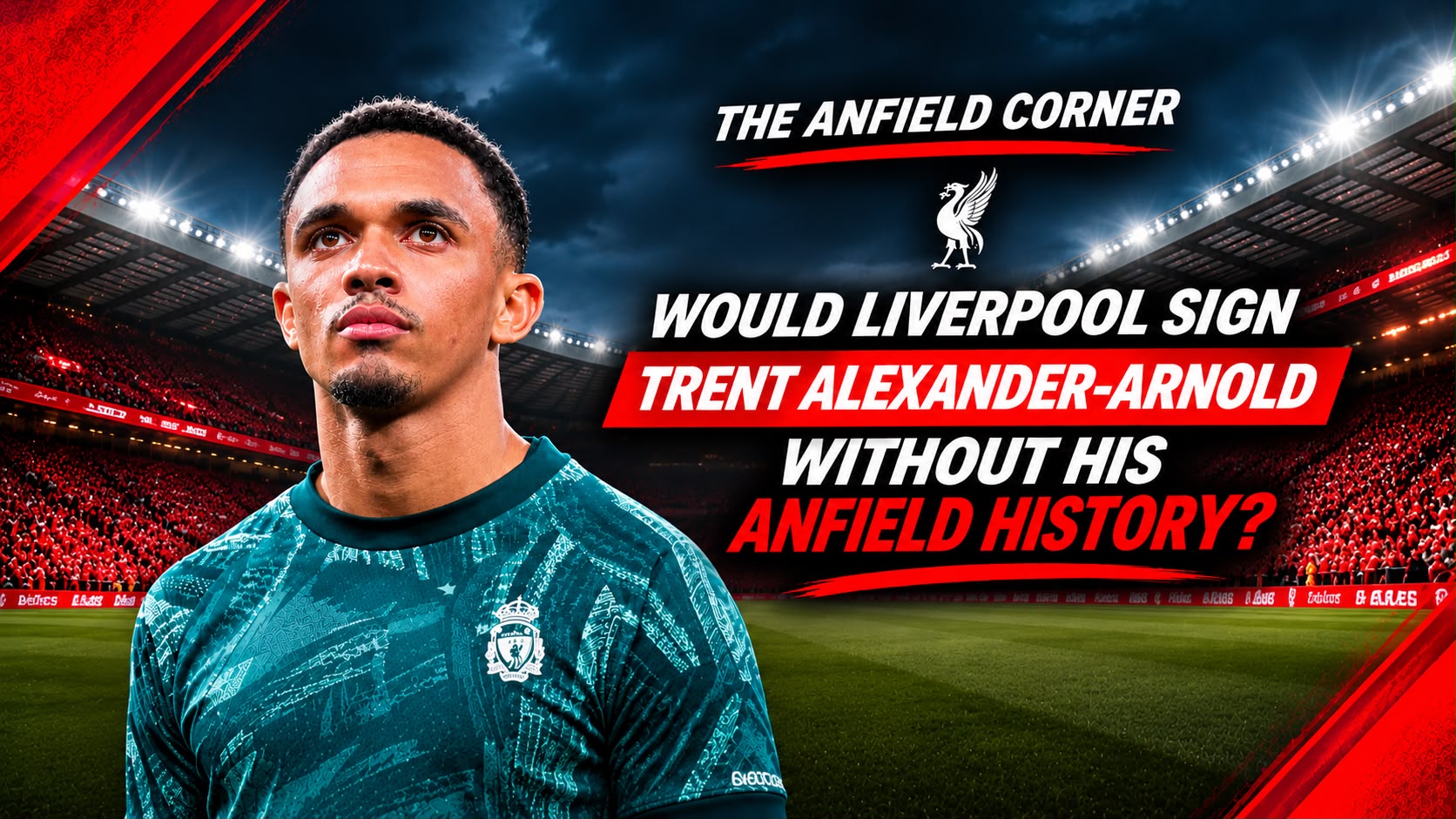
Age, wages, availability and resale value: would a Trent reunion make footballing sense, or would nostalgia cloud the judgement?
Trent Alexander-Arnold’s Liverpool story makes the idea of a return difficult to judge on football alone. The academy graduate became one of the game’s most creative full-backs, helped the Reds win major honours and left for Real Madrid in 2025.
For supporters debating a possible reunion, there is a more revealing question than whether we would welcome him back: would we want Liverpool to sign him if he had never played for the club?
That is the test this article applies. A return is a hypothetical recruitment decision, not a confirmed move, and sentiment cannot settle it.
Trent’s Liverpool record
His record at Anfield explains why a reunion would carry such appeal. Across his senior Liverpool career from 2016 to 2025, his all-competitions totals were:
- Appearances: 354.
- Goals: 23.
- Assists: 86.
Trophies won with Liverpool:
- Premier League: 2019/20 and 2024/25.
- UEFA Champions League: 2019.
- FA Cup: 2022.
- League Cup: 2022 and 2024.
- UEFA Super Cup: 2019.
- FIFA Club World Cup: 2019.
- FA Community Shield: 2022.
That is a substantial legacy. The challenge is to recognise what he achieved without assuming that past success makes a future transfer the right decision.
What would Trent bring?
The appeal is obvious. Trent’s passing range, crossing, vision and set-piece delivery can give a team an attacking dimension that few right-backs offer.
He can switch play, break defensive lines and create chances from deep. Against a compact defence, that creativity could be a powerful asset.
His familiarity with Liverpool and the demands of Anfield would be another attraction. But knowing what a player can offer is only the starting point: the club would still need to establish whether he is the right signing.
Age: immediate quality or long-term value?
At 28, Trent could still have several productive seasons ahead of him. Age alone is not a reason to dismiss a deal.
Personally, I believe Trent’s best years are behind him. For me, his physical peak came during Liverpool’s Champions League-winning 2018/19 campaign and the Premier League title-winning season that followed. That was the Trent I remember bombing down the right flank, playing with energy and freedom and becoming, in my view, the main creative source in Klopp’s Liverpool.
That is my assessment as a supporter, not a medical judgement. He still has exceptional quality on the ball, but I am not convinced a return would bring back the same physical dynamism that made him so influential at his best.
The question is what Liverpool would be buying over the full length of a contract. Recent performances, physical condition and the role he would play matter more than a simple age cut-off.
An established player can deliver immediate quality. A younger alternative may offer more room to develop and greater resale potential. Liverpool would need to weigh those benefits without giving Trent special treatment because of his past.
Availability: the injury question
Availability deserves as much attention as ability, particularly when a deal could involve a sizeable fee and a long-term contract.
The season-by-season injury-record summary examined for this article lists these absences:
- 2023/24: 103 days and 23 games missed.
- 2024/25: 64 days and 11 games missed.
- 2025/26: 106 days and 24 games missed.
Missed games do not tell the whole story, and past injuries do not make future problems inevitable. The causes of each absence, recovery, current fitness and the demands of the proposed role would all need a medical assessment.
The recruitment question is whether Liverpool could reasonably expect enough consistent contribution to justify the investment. That is a judgement about risk and value, not a dismissal of Trent’s talent.
Wages and transfer fee: would the numbers add up?
The financial case extends well beyond a transfer fee.
Any deal would also depend on salary expectations, bonuses, contract length and other costs. Without verified terms, the full price of a reunion remains uncertain.
The crucial question is opportunity cost: could Liverpool use the same resources more effectively elsewhere?
Strengthening another position or investing in a younger player could offer a better balance of immediate impact and long-term value. Equally, a substantial outlay could be justified if Trent provided something the team genuinely lacked.
His Anfield history should not make a fee or wage package acceptable if Liverpool would reject it for an otherwise comparable player.
Would he fit Liverpool’s recruitment model?
For me, this is the heart of the debate. Being good enough to play for Liverpool is not the same as being the right player for Liverpool to recruit.
A sensible assessment would consider age, development potential, availability, resale value and long-term squad needs alongside what Trent could deliver immediately.
That does not mean an established player is automatically the wrong investment. It means the case for signing him must stand on its own.
If Liverpool committed to a substantial fee and high wages, the main return might have to come through performances rather than a future sale. The contract would need to reflect that balance.
We cannot know exactly how Liverpool would assess the deal internally. But supporters can ask whether the same age, cost and availability profile would appeal if the player had no connection to Anfield.
Would he fit the team on the pitch?
The tactical case matters just as much as the financial one.
Trent’s creativity could give Liverpool an extra playmaker in possession. The question is whether that quality fits the role the manager needs, rather than whether the team can recreate what worked in the past.
Liverpool would need to weigh his defensive responsibilities, the cover around him and the options already in the squad. Every signing involves trade-offs.
Would his return improve the team’s overall balance? Could his strengths be used without asking too much of others? Or would a different type of player be a better fit?
The emotional pull of an Anfield return
For fans, separating the player from the memories is the hardest part.
Trent’s academy roots, major honours and role in Liverpool’s success give a potential reunion an emotional weight that another signing would not carry.
Some supporters would welcome him home; others would find his departure harder to put aside. Neither reaction, by itself, answers whether a transfer would improve Liverpool.
The club should neither sign him to recreate the past nor rule him out simply because he left. The decision has to serve the team’s future.
The verdict: football first, sentiment second
A Trent return could make sense, but only on the right terms. His creativity and familiarity with Liverpool are genuine attractions; availability, total cost and tactical fit are equally important tests.
Personally, I would be cautious about bringing him back because I believe his best years are behind him. His history should earn him neither a recruitment shortcut nor an automatic rejection, but Liverpool would need a convincing case that the player he is now, rather than the player we remember represents the right investment.
Over to you: if Trent had never played for Liverpool, would you want the club to sign him today?
Share your view in the comments: would his quality justify a reunion, or should Liverpool invest elsewhere?
Anfield Corner — bringing Liverpool supporters together, one debate at a time.
Leave a Reply